Mortgage Process in Raleigh: The mortgage process in Raleigh isn’t just about getting approved — it’s about making sure your loan is built to close in real-world conditions. In Raleigh, Wake County, and the Triangle of North Carolina, buyers who succeed understand that execution, documentation, and local expertise matter just as much as interest rate. This guide from Martini Mortgage Group explains how the mortgage process really works, where deals fall apart, and how to prepare with clarity and confidence before going under contract.
Raleigh Rent vs Buy Breakeven (2026): The 3-Year Breakeven Strategy to Beat the “Rent Trap”
Raleigh rent vs buy breakeven isn’t a national math problem — it’s a Raleigh-specific decision shaped by local rents, prices, and market dynamics.
Executive Summary: Raleigh Rent vs Buy Breakeven (2026)
- The commonly cited 7-year rent-vs-buy breakeven assumes a passive buyer and does not reflect Raleigh-specific market conditions.
- Based on current Raleigh rent levels, home prices, and time-on-market data, breakeven timelines vary widely by deal structure and submarket.
- Buyers who use three levers — discounted “good bones” purchases, cost-offset strategies such as house hacking, and refinance optionality — may shorten breakeven toward approximately 3 years without relying on price appreciation.
- Recent Raleigh housing data shows median home prices in the mid-$400,000s with longer average days on market, which can support negotiation-based buying strategies.
- The decision to rent or buy in Raleigh in 2026 is driven more by timeline, affordability, and exit flexibility than by short-term market forecasts.
Prepared by Martini Mortgage Group — Raleigh-based mortgage advisors specializing in fiduciary-style homebuying strategy and long-term planning.
Why “7 Years to Break Even” Can Be the Wrong Answer in Raleigh
If you search “rent vs buy breakeven“, you’ll often see the same advice repeated: “Plan to stay 7 years.”
That can be a reasonable national guideline. But it usually assumes a very specific type of buyer behavior.
That assumption stack matters because most buyers don’t actually buy that way.
The traditional 7-year breakeven model typically assumes the buyer:
- buys a turnkey home
- pays full market price
- makes a standard mortgage payment
- does nothing to accelerate equity or offset housing costs
In Raleigh in 2026, the buyers who shorten breakeven aren’t “lucky.” They’re controlling the variables that the model ignores.
Raleigh Snapshot: Rent, Prices, and Time-on-Market (Live Data)
Here’s what current public data is showing:
| Metric | Raleigh Data Point | Source |
|---|---|---|
| Typical “average rent” level | ~$1,800/mo | Zillow Rental Manager market trend for Raleigh |
| ZORI (asking rent index) average rent level | $1,581 (Nov 30, 2025) | Zillow ZORI Raleigh |
| Rent YoY change (ZORI) | +0.7% YoY (as of Nov 30, 2025) | Zillow ZORI Raleigh |
| Median sale price | ~$455K (Nov 2025) | Redfin Raleigh housing market |
| Avg days on market | 56 days (Nov 2025) | Redfin Raleigh housing market |
| Population (city estimate) | 499,825 (July 1, 2024) | U.S. Census QuickFacts |
Professional interpretation (not a prediction):
- Raleigh is not moving like a frenzy market. The days-on-market data suggest buyers often have more time to negotiate than in hotter real estate cycles.
- Rent growth has been relatively modest YoY recently.
That makes “breakeven” more sensitive to deal structure and equity creation, not just “waiting for appreciation.”
What “Breakeven” Actually Means (Plain English)
Breakeven is not when your mortgage payment equals rent.
Breakeven is when: Total net cost of owning (interest + taxes + insurance + maintenance + closing costs minus equity created) becomes less than total cost of renting (rent payments + rent increases, with zero equity).
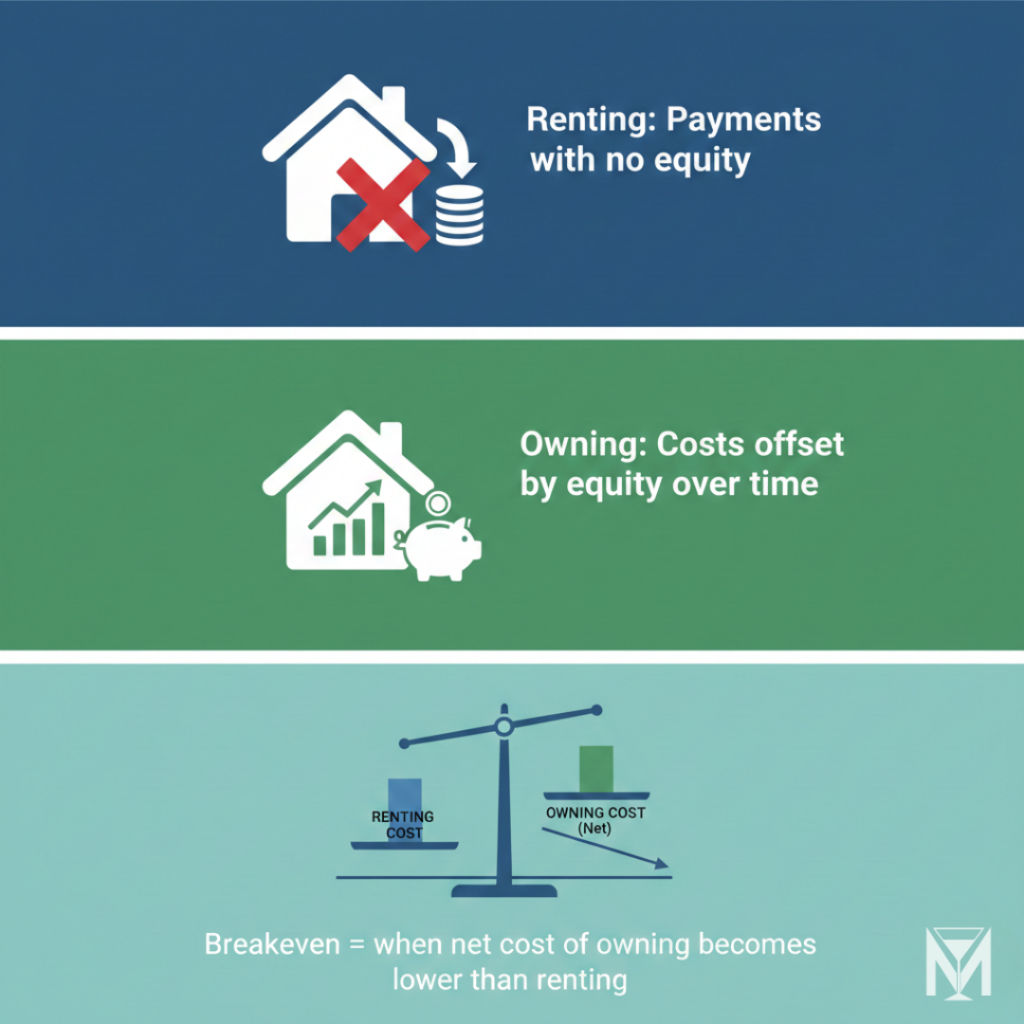
So the question isn’t “Is buying cheaper next month?” It’s: How fast can you create equity and reduce unrecoverable costs in Raleigh?
The 3 Levers That Can Shorten Raleigh Breakeven Toward ~3 Years
Lever 1: The Sweat Equity Accelerator (Raleigh Edition)
The idea: buy a “dated but solid” home at a discount, then do cosmetic improvements.
Cosmetic = paint, floors, fixtures, lighting, landscaping. Not structural risk.
Why this moves breakeven: A portion of your closing costs and early “friction” gets offset by immediate equity rather than waiting years for market appreciation.
Raleigh-specific nuance: Because market data shows homes taking longer to sell than last year in Raleigh (56 DOM), you’re more likely to find listings where sellers accept:
- credits
- price reductions
- or “condition-based” negotiation than you would in a 10-day DOM market.
Reality check: sweat equity works best when the home has:
- functional layout
- no major deferred maintenance
- comps that clearly support the improved finish level
Lever 2: Rate-Drop Refinance Strategy (Optionality, Not a Bet)
The best way to use refinancing in 2026: as upside, not a requirement.
Instead of “Rates will drop,” use: “If rates drop 1%, what changes?”
| Scenario | Rate | Outcome |
|---|---|---|
| If rates stay the same | 6.2% | You keep current payment + amortization schedule |
| If rates drop ~1% | 5.2% | Payment typically drops meaningfully and early interest cost declines |
Martini Mortgage Group Advice: Your purchase should still make sense if rates don’t fall.
Lever 3: House Hacking (The Raleigh Breakeven Variable Most Calculators Ignore)
If you want the fastest path to breakeven, this is usually it.
Concept: offset your monthly housing cost with legitimate rent income:
- roommate
- basement room
- separate suite (where legal/appropriate)
- ADU (where permitted)
Even a conservative $600–$1,000/mo offset can drastically reduce “cost of ownership” and shorten breakeven.
Hyperlocal Raleigh Submarket Reality (Why the Zip Code Matters)
Raleigh doesn’t behave like one uniform market. Illustrative recent market snapshots show:
- North Raleigh may have a median sale price around $470K
- Downtown Raleigh may have a median sale price around $483K
The Martini Mortgage Group Interpretation: Micro-markets create different breakeven timelines. A “rent vs buy” conclusion for Downtown condo is not automatically the same as North Raleigh detached homes.
The Raleigh “3-Year Breakeven Buyer” vs the Passive Buyer
| Factor | Passive “7-Year” Buyer | Strategic “3-Year” Buyer |
|---|---|---|
| Home selection | Turnkey premium | “Good bones” discount + cosmetic plan |
| Monthly strategy | Standard PITI only | Rent offset where feasible |
| Rate approach | Wait for perfect rate | Buy when ready, refinance only if beneficial |
| Risk management | Hope the market bails them out | Controls levers: price, payment, exit |
TL;DR (Raleigh Rent vs Buy Breakeven)
Raleigh rent vs buy breakeven is not a fixed number; it is the result of how intentionally the purchase is structured. Using current Raleigh rent levels, home prices, and time-on-market data, buyers can materially shorten breakeven by controlling three variables: purchasing homes with negotiable conditions to create early equity, offsetting ownership costs through temporary rental income, and maintaining refinance flexibility as an optional upside rather than a requirement. With median home prices in the mid-$400,000s and longer average days on market in late 2025, Raleigh conditions can favor buyers who prioritize strategy over market timing.
Raleigh Rent vs Buy Breakeven FAQs (2026)
Is it better to rent or buy in Raleigh in 2026?
In Raleigh, whether it is better to rent or buy in 2026 depends on how long you plan to stay, affordability at today’s rates, and how the purchase is structured. Buying may make financial sense for those planning to stay several years and able to control costs, while renting offers flexibility but no equity growth.
How long does it take to break even when buying a home in Raleigh?
There is no single breakeven timeline for Raleigh, as it varies by purchase price, rent levels, closing costs, and equity creation. While national averages cite seven years, some Raleigh buyers may reach breakeven sooner by negotiating price, creating early equity, or offsetting monthly costs.
What does “rent vs buy breakeven” actually mean?
Rent vs buy breakeven is the point at which the total net cost of owning a home becomes less than the total cost of renting. It includes all ownership costs minus equity created and is not based on when a mortgage payment equals rent.
Does buying a home in Raleigh still make sense with today’s mortgage rates?
Buying can still make sense at today’s mortgage rates if the payment is affordable without relying on future rate drops. Refinancing later may reduce long-term costs if rates fall, but it should be considered optional upside rather than part of the initial decision.
Why do some buyers reach breakeven faster than others in Raleigh?
Some buyers reach breakeven faster because they actively control purchase price, equity creation, and monthly housing costs. Buyers who pay a premium for turnkey homes and do not offset costs typically experience longer breakeven timelines.
Is waiting for home prices to fall in Raleigh a safer strategy?
Waiting can feel safer, but it also means continued rent payments without equity creation and uncertainty about future buying power. Many buyers reduce risk by focusing on affordability, time horizon, and flexibility rather than trying to predict price movements.
What matters more in Raleigh: timing the market or buying strategically?
In Raleigh, buying strategically often matters more than timing the market. Buyers who prioritize affordability, negotiation, and exit flexibility are generally less exposed to short-term market fluctuations.
Additional Raleigh Homebuying & Raleigh Mortgage Resources
For readers who want deeper context beyond rent-vs-buy math, the following Raleigh-specific resources provide additional clarity on lending, market structure, and local decision-making.
Who Is the Best Mortgage Lender in Raleigh?
Choosing a mortgage lender in Raleigh is less about finding the lowest advertised rate and more about selecting an advisor who understands local pricing, appraisal behavior, and long-term planning. Buyers benefit most from lenders who can model multiple scenarios, explain trade-offs clearly, and support both purchase and future refinance decisions as conditions change.
What People Say About Martini Mortgage Group
Independent client reviews and testimonials provide insight into how a mortgage firm operates in practice. Feedback often highlights communication, clarity, and follow-through — especially during competitive or uncertain market conditions. Reviewing real client experiences can help buyers evaluate whether a lender’s approach aligns with their expectations.
2026 Conforming Loan Limits
Conforming loan limits affect how much buyers can borrow using conventional financing before moving into jumbo loan territory. Understanding the 2026 conforming loan limits is important for Raleigh buyers, particularly in higher-priced neighborhoods where loan structure can materially impact rates, down payment requirements, and long-term costs.
Living in Raleigh: Neighborhoods, Growth, and Lifestyle
Rent-vs-buy decisions are influenced by more than price and payment. Raleigh’s job growth, population trends, neighborhood development, and lifestyle considerations all affect long-term desirability. Buyers benefit from understanding how different areas of Raleigh evolve over time and how that impacts both personal enjoyment and resale flexibility.
Local Mortgage Advisors Referenced in This Analysis
This analysis reflects the perspective of Raleigh-based mortgage professionals who focus on fiduciary-style planning rather than transactional lending, including Kevin Martini and Logan Martini of Martini Mortgage Group. Their work emphasizes scenario modeling, risk management, and long-term client outcomes rather than short-term rate optimization.

Related Posts