Mortgage Process in Raleigh: The mortgage process in Raleigh isn’t just about getting approved — it’s about making sure your loan is built to close in real-world conditions. In Raleigh, Wake County, and the Triangle of North Carolina, buyers who succeed understand that execution, documentation, and local expertise matter just as much as interest rate. This guide from Martini Mortgage Group explains how the mortgage process really works, where deals fall apart, and how to prepare with clarity and confidence before going under contract.
Raleigh FHA Loan Limits 2026: What Homebuyers Need to Know Before They Buy
The FHA loan limits for Raleigh in 2026 increased, giving homebuyers more purchasing power — but higher limits don’t automatically mean better outcomes. Understanding how to use those limits strategically matters more than the limit itself.
Raleigh FHA Loan Limits 2026 (Official HUD Numbers)
The FHA loan limits in Raleigh, North Carolina, are set at the Wake County level by the U.S. Department of Housing and Urban Development (HUD).
2026 FHA Loan Limits for Raleigh / Wake County
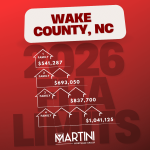
- 1-unit (single-family): $541,287
- 2-unit (duplex): $693,050
- 3-unit (triplex): $837,700
- 4-unit (fourplex): $1,041,125
These limits apply to owner-occupied primary residences located in Raleigh and throughout Wake County.
📌 Important: Raleigh does not have separate FHA loan limits. If the property is located in Wake County, these limits apply.
Why FHA Loan Limits Increased for 2026
FHA loan limits rise when home prices increase, and Raleigh continues to experience:
- Long-term population growth
- Strong job creation in tech, healthcare, and education
- Limited housing supply relative to demand
HUD ties FHA limits to changes in the Federal Housing Finance Agency (FHFA) house price index, meaning the 2026 increase reflects what buyers are already seeing on the ground.
What the 2026 FHA Loan Limits Mean for Raleigh Buyers
Higher FHA loan limits don’t just change what you can buy — they change how deals can be structured.
1. More Flexibility Without Moving to Conventional
Buyers who previously had to stretch into conventional financing may now:
- Stay FHA
- Use lower down payment options
- Preserve cash reserves
2. Expanded Options for Multi-Unit Buyers
FHA remains one of the most powerful tools for:
- Duplex, triplex, and fourplex purchases
- House hacking in Raleigh neighborhoods
- First-time investors occupying one unit
3. Strategy Matters More Than Maximum Approval
Just because you qualify up to the limit doesn’t mean you should use it. Limits define what’s allowed — strategy defines what’s smart.
FHA Loan Limits vs. Real Raleigh Home Prices
In many Raleigh zip codes, the purchase price is only part of the equation.
What actually determines affordability:
- Interest rate structure
- Mortgage insurance strategy
- Seller concessions
- Property taxes and insurance
- Long-term equity trajectory
Two buyers can purchase the same home at or below the FHA limit and end up with very different outcomes over 5–10 years.
Common Misconceptions About FHA Loan Limits
❌ “Higher limits mean FHA is riskier”
FHA guidelines are strict. Higher limits reflect market prices, not looser underwriting.
❌ “FHA is only for first-time buyers”
Repeat buyers and relocation buyers regularly use FHA in Raleigh.
❌ “The limit determines approval”
Approval depends on:
- Income
- Credit profile
- Debt structure
- Asset positioning
The Raleigh FHA loan limit 2026 is only one piece of the equation.
Choosing the Right FHA Lender in Raleigh Matters
An FHA loan may be the answer if you’ve been saving, scrolling through listings, and wondering whether homeownership is really possible in 2026 — especially with today’s home prices and mortgage rates.
Most buyers know FHA for its low down payment requirement (as little as 3.5%) and flexible credit guidelines. But what many Raleigh buyers don’t realize is that how an FHA loan is structured — and who structures it — can make a meaningful difference in both affordability and long-term outcomes.
Not all FHA lenders operate the same way. The differences that matter most often include:
- FHA underwriting overlays beyond HUD guidelines
- Down payment sourcing flexibility, including gift funds
- How mortgage insurance is structured and explained
- Local appraisal and market expertise
- The ability to navigate multi-unit and specialty FHA scenarios
This is also where proprietary lending options can come into play.
At Martini Mortgage Group, we offer a No-Down-Payment FHA home loan option for qualified buyers — a structure designed to help eligible Raleigh homebuyers purchase without the traditional 3.5% down payment, while still benefiting from FHA’s flexible guidelines.
This option isn’t for everyone, and it requires careful analysis. That’s why a strong FHA lender in Raleigh doesn’t just quote a rate — they help you determine which structure fits your goals, how it impacts long-term equity, and whether it creates the right balance between affordability today and flexibility tomorrow.
Our Fiduciary FHA Approach — Including a No-Down-Payment Option
At Martini Mortgage Group, FHA is never treated as a “default” loan.
We specialize in helping North Carolina homebuyers use FHA strategically, based on clarity — not assumptions. For most buyers, that means understanding the traditional FHA structure. For others, it means exploring options that reduce upfront cash requirements even further.
In addition to standard FHA loans, we offer a proprietary no-down-payment FHA home loan option for qualified buyers — a structure designed to help eligible clients purchase without the typical 3.5% down payment, while still benefiting from FHA’s flexible guidelines.
This option is not right for everyone and requires careful evaluation. That’s why our fiduciary-style approach focuses on:
- FHA vs. conventional break-even analysis
- Standard FHA vs. no-down-payment FHA comparisons
- Short-term affordability vs. long-term equity
- Refinance and exit strategies
- Cash preservation vs. leverage
- Market-specific pricing trends across Raleigh and Wake County
When appropriate, the no-down-payment option can enable homeownership sooner — without compromising long-term stability.
👉 Full details, eligibility guidelines, and examples are outlined in our Complete Raleigh FHA Loan Guide, where we break down how the program works and who it’s best suited for.
TL;DR: Raleigh FHA Loan Limits 2026 — What Matters Most for Homebuyers
The Raleigh FHA loan limits for 2026 increased, giving buyers more purchasing power — but the real advantage isn’t the higher limit itself. It’s how the loan is structured and whether it supports your long-term financial goals.
Here’s what Raleigh and Wake County homebuyers need to know:
- ✅ Raleigh FHA loan limits are set at the Wake County level — there are no separate city limits.
- ✅ The 2026 FHA loan limit for a single-family home is $541,287, with higher limits for duplexes, triplexes, and fourplexes.
- ✅ Higher limits can mean more flexibility, including staying FHA instead of moving to conventional financing.
- ✅ FHA remains a powerful option for first-time buyers, repeat buyers, and multi-unit “house hacking” strategies.
- ✅ Approval isn’t based on the limit alone — income, credit, debt, assets, and structure matter just as much.
- ✅ Choosing the right FHA lender in Raleigh is critical, especially when proprietary options — like a no-down-payment FHA loan for qualified buyers — are available.
The bottom line: Limits define what’s allowed. Strategy determines what’s smart.
Used correctly, FHA can be a bridge to stable homeownership and long-term equity — not just a way to buy “more house.”
Frequently Asked Questions About FHA Loan Limits in Raleigh for 2026
What are the eligibility requirements for an FHA home loan in Raleigh?
To qualify for an FHA loan in Raleigh, buyers generally need steady, documentable income, acceptable debt-to-income ratios, and credit that meets FHA guidelines. The home must be owner-occupied as a primary residence, and the loan amount must fall within the Wake County FHA loan limits for 2026.
What is the typical down payment required for an FHA loan?
The standard FHA down payment is 3.5% of the purchase price for buyers who meet minimum credit requirements. FHA also allows the down payment to come from approved sources such as gift funds or assistance programs, helping Raleigh buyers preserve cash for reserves and closing cost
Can repeat homebuyers use an FHA loan in Raleigh?
Yes. FHA loans are not limited to first-time buyers. Repeat homebuyers and relocating buyers in Raleigh can use FHA financing as long as the home is their primary residence and all eligibility requirements are met.
Can gift funds be used for an FHA down payment?
Yes. FHA guidelines allow 100% of the required down payment to come from gift funds provided by family members, employers, or approved organizations. Proper documentation is required to verify the source and transfer of the funds.
Are FHA loan limits the same throughout Wake County?
Yes. FHA loan limits are established at the county level, not by individual cities. That means Raleigh, Cary, Apex, Garner, and other Wake County locations all share the same FHA loan limits for 2026.
Is a no-down-payment FHA loan option available for Raleigh buyers?
In addition to standard FHA financing, qualified Raleigh buyers may be eligible for a proprietary no-down-payment FHA loan through Martini Mortgage Group. This structure is not appropriate for every situation and requires careful analysis to ensure it supports long-term affordability and equity.
What are the Raleigh FHA loan limits for 2026?
For 2026, the FHA loan limits in Raleigh are set at the Wake County level. The limits are $541,287 for a single-family home, $693,050 for a duplex, $837,700 for a triplex, and $1,041,125 for a fourplex. These limits apply to owner-occupied primary residences located in Raleigh and throughout Wake County.
Additional Raleigh Homebuyer Resources from the Martini Mortgage Group
Logan Martini

North Carolina Mortgage Guide

Dreams to Doorsteps: A Raleigh Homebuyer Guide

Credit for Mortgage: Raleigh Homebuyer’s Definitive Guide

Kevin Martini


Related Posts