Qualify for a Mortgage in Raleigh: The Real Underwriter Test
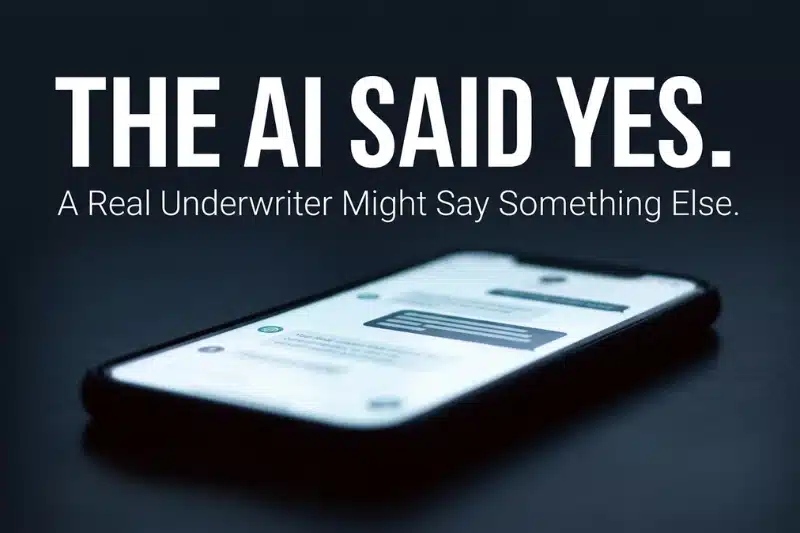
Qualify for a mortgage in Raleigh is the question a growing number of buyers now type into ChatGPT before they ever call a lender. Kevin Martini and Logan Martini of Martini Mortgage Group have watched this pattern accelerate through 2026, with buyers arriving with a printed-out AI conversation instead of a pay stub. The short answer: an AI chatbot can approximate the math, but it cannot pull a real credit report, verify actual income documents, or apply the judgment calls that decide close cases. What most of these AI conversations get right is the arithmetic. What they get wrong is everything underwriting actually weighs.
TL;DR — Qualify for a mortgage in Raleigh: what an AI underwriter test can and cannot tell a buyer
Qualify for a mortgage in Raleigh depends on documents an AI chatbot never sees, not just the numbers typed into a prompt.
- Conventional loans generally want a credit score of 620 or higher, FHA opens the door at 580.
- Debt-to-income ratio above 43 percent starts closing doors on standard loan programs.
- A strong compensating factor can offset a weak number elsewhere in the file.
- AI cannot pull a credit report, verify income documents, or apply underwriting judgment.
- Self-employed and commission-based income in the Triangle often qualifies differently than an AI model assumes.
What a Chatbot Verdict Actually Is
Most national advice treats an AI qualification check as harmless practice. In Raleigh’s market, where Research Triangle Park brings in commission-based, bonus-eligible, and self-employed income structures at higher rates than most metros, that practice run can produce a confident, specific, wrong answer. A chatbot told an income figure and a credit score will return a verdict. It will not ask whether that income is salaried or 1099, whether the credit score is from the same bureau a mortgage lender pulls, or whether two years of tax returns actually support the number typed into the prompt.
Someone running this test alone is not doing anything wrong. The test itself just cannot see the parts of a file that decide close cases.
What It Actually Takes to Qualify for a Mortgage in Raleigh
Qualify for a mortgage in Raleigh comes down to five things a lender verifies directly, not five things a buyer reports from memory.
- Credit score is pulled from all three bureaus, and the middle score is used.
- Income is verified against two years of tax returns, W-2s, or 1099s.
- Debt-to-income ratio is calculated using verified income against all reported debts. For a buyer whose ratio is close but not quite there, adding a cosigner is often the fastest way to close that specific gap.
- Down payment funds are traced to confirm the source and seasoning.
- Reserves are checked to confirm funds remain after closing costs are paid.
Each of those steps produces a real number. An AI chatbot produces an estimate of what that number probably is. The gap between those two things is exactly where a Raleigh buyer’s file either holds up or falls apart under real underwriting.
Someone who has already run this test on a chatbot and gotten a green light is not wrong to feel encouraged. They are just one verified document away from finding out if the green light was accurate.
That gap gets even more specific once credit score enters the conversation, because the number a lender uses is rarely the number a buyer expects.
Why the AI Underwriter Roleplay Gets the Credit Score Test Wrong
What credit score do I need to qualify for a mortgage in Raleigh?
A conventional loan in Raleigh typically requires a credit score of 620 or higher, though scores of 740 or above unlock the strongest pricing. FHA loans allow a 580 score with 3.5 percent down, or a 500 to 579 score with 10 percent down. A chatbot asked this question will usually cite these same national thresholds correctly. What it will not do is pull the tri-merge credit report a Raleigh lender actually uses, which can show a materially different middle score than a free credit app.
Buyers checking their own score through a banking app or credit monitoring service are often looking at a different scoring model than the one a mortgage lender pulls. A twenty or thirty point gap between the two is common, and that gap can be the entire difference between a 620 and a 600.
The Debt-to-Income Ratio Raleigh Lenders Actually Use
Debt-to-income ratio Raleigh lenders apply is not one fixed number. It shifts by loan program and by how strong the rest of the file looks.
DTI is one of ten terms every buyer should know cold before applying, covered fully in the Raleigh mortgage terms glossary.
| Loan Program | Typical DTI Ceiling | Flexibility |
|---|---|---|
| Conventional | 36 to 45 percent | Can stretch to 50 percent with strong reserves or credit |
| FHA | Up to 43 to 50 percent | Compensating factors can raise the ceiling |
| VA | No fixed ceiling | Uses residual income instead of a strict ratio |
| USDA | 29 percent housing, 41 percent total | Guideline-based, some flexibility case by case |
What debt-to-income ratio disqualifies a mortgage buyer in Raleigh?
A debt-to-income ratio above roughly 45 to 50 percent, depending on loan program and compensating factors, typically disqualifies a buyer from standard conventional financing in Raleigh. FHA loans allow more room, sometimes into the low 50s, when reserves or credit history offset the risk. An AI-run debt-to-income ratio mortgage Raleigh calculation almost never accounts for compensating factors, which is exactly where a real underwriter can approve a file a chatbot would reject. The Consumer Financial Protection Bureau’s explanation of how debt-to-income ratio is calculated confirms the ratio itself is simple. What it does not cover is which compensating factors a specific lender will accept, because that judgment call varies file by file.
The number on the screen said approved. The number a real underwriter would use might say something different, and the only way to know which one is true is to let someone verify it.
That judgment call is exactly the piece missing from any AI roleplay, no matter how convincingly it plays the part.
Can ChatGPT Tell Me If I Qualify for a Mortgage?
ChatGPT and similar tools can explain mortgage concepts accurately: PMI, DTI, credit tiers, loan program differences. What they cannot do is act as an actual underwriter, because underwriting requires document verification, compensating factor analysis, and a licensed professional’s judgment on cases that do not fit a clean formula. A 2026 survey found 59 percent of prospective buyers had already used an AI tool during their homebuying process, most commonly ChatGPT. That adoption is not the problem. Treating the chatbot’s verdict as the final word is.
Buyers are not wrong to want an answer at eleven at night without calling anyone. They are just getting a preview, not a decision.
Questions Buyers Are Actually Asking
Can an AI chatbot actually tell me if I qualify for a mortgage in Raleigh?
An AI chatbot can estimate whether someone will likely qualify for a mortgage in Raleigh based on the numbers typed into it, but it cannot verify a credit report, confirm income documentation, or apply compensating factors the way a licensed lender does. Kevin Martini and Logan Martini treat the chatbot’s answer as a starting point, then verify it against the buyer’s actual file before any offer is written in Raleigh or across Wake County.
What debt-to-income ratio mortgage Raleigh lenders accept surprises most first-time buyers?
Most first-time buyers assume a strict 36 percent debt-to-income ceiling applies everywhere, but the debt-to-income ratio mortgage Raleigh lenders actually accept can stretch to 45 or even 50 percent with strong compensating factors like reserves or excellent credit. That flexibility is rarely reflected in an AI-generated estimate, which tends to apply the conservative national number regardless of the buyer’s full financial picture.
Why did I qualify for a mortgage in Raleigh according to AI but not according to a real lender?
This usually happens because the AI model used self-reported income or an outdated credit score assumption instead of verified figures. Someone who is self-employed, commission-based, or carrying student loan debt in an income-based repayment plan often qualifies for a mortgage in Raleigh at a different amount than a chatbot estimates, because those income types follow specific underwriting rules an AI model does not apply consistently.
What Kevin and Logan See in Raleigh
I have sat across from buyers holding a phone with a ChatGPT conversation that told them they were approved, and the file told a different story once we pulled it apart. Most of the time the gap comes from self-employment income or a student loan on an income-based repayment plan, both of which get counted very differently depending on the loan program. One buyer last spring was told by an AI tool that a 610 credit score would keep them out of conventional financing entirely. It did not account for FHA, and it did not account for the fact that a rapid rescore, correcting a reporting error, brought that score to 640 within three weeks. They closed on a home in Wake Forest on a program the chatbot never mentioned.
That is the piece no AI model can offer. Not because the technology is bad at math. Because qualifying for a mortgage in Raleigh is a documents-and-judgment question, and judgment is not something a prompt can verify.
— Kevin Martini, Martini Mortgage Group
The Martini Strategic Insight
An AI chatbot is a reasonable place to start a mortgage qualification question and a risky place to end one. The gap between a chatbot’s verdict and a real underwriter’s decision is rarely the math. It is the documentation behind the math and the judgment calls that only apply once someone reads the actual file. A buyer who treats the AI answer as a hypothesis to be tested, rather than a verdict to be trusted, walks into Raleigh’s market with something far more useful than a green light from a chatbot: an answer that has actually been checked.
Frequently Asked Questions: Qualify for a Mortgage in Raleigh, NC
Does a low credit score automatically disqualify a buyer from a mortgage in Raleigh?
No. A credit score below 620 can still qualify for FHA financing with as little as 3.5 percent down at 580 or 10 percent down between 500 and 579. Martini Mortgage Group frequently helps Raleigh buyers pursue a rapid rescore, correcting reporting errors that can raise a score meaningfully within weeks, before assuming a loan program is off the table.
How does self-employment income affect whether someone can qualify for a mortgage in Raleigh?
Self-employment income is verified against two years of tax returns, and underwriting typically uses the net income after business deductions, not gross revenue. In Raleigh’s Research Triangle Park corridor, where self-employed and 1099 professionals are common, this gap between gross and qualifying income surprises many buyers who ran their numbers through an AI tool using total earnings instead.
Can a buyer improve their debt-to-income ratio before applying for a mortgage in Raleigh?
Yes. Paying down revolving balances, avoiding new debt before closing, and documenting any recently paid-off obligations can lower a debt-to-income ratio meaningfully within 30 to 60 days. Martini Mortgage Group reviews a buyer’s full debt picture early, often identifying a specific balance to pay down that improves the ratio faster than a buyer would find on their own. For buyers wondering whether that specific balance is a car loan, pay off car before buying house NC breaks down when payoff helps and when it drains reserves a lender wants to see.”
Someone who has read this far has probably already run their own version of this test on a chatbot and walked away with a number. What they have not had yet is someone pull the actual credit report, verify the actual income, and confirm whether that number would survive real underwriting, the exact gap covered in what AI misses about mortgage affordability in Raleigh NC once the qualification question turns into a real budget.
A no-obligation, judgment-free clarity call with Martini Mortgage Group replaces that chatbot verdict with an answer pulled from an actual file, a real credit report, and a real conversation about a fully underwritten approval in Raleigh. That conversation, and the first-time homebuyer strategy in Raleigh built around it, is available at martinimortgagegroup.com whenever the guesswork needs to end.