FHA vs Conventional 680 Credit Score: The Real Answer
KEY POINTS: How Credit Score Changes the FHA vs Conventional Math
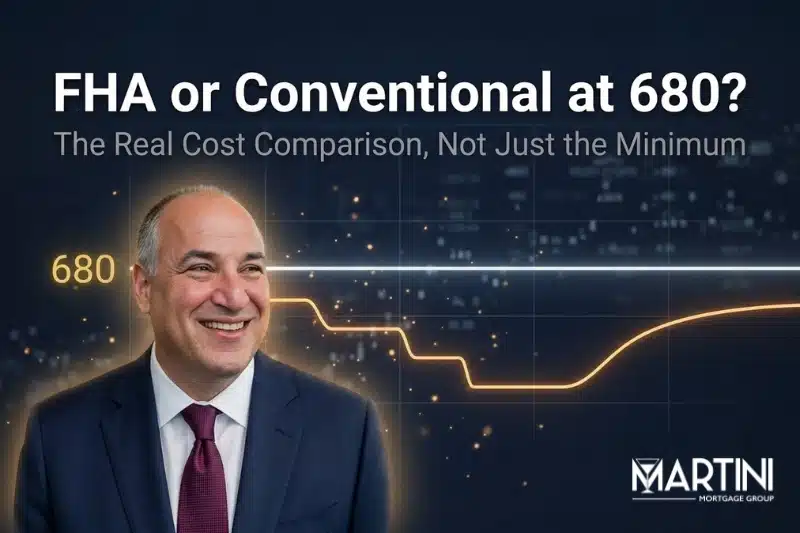
The FHA vs conventional 680 credit score decision in Raleigh comes down to pricing, the mortgage insurance cost, and the interest rate itself, not the credit score minimum alone.
- FHA requires 3.5 percent down and prices mortgage insurance the same at 680 as it does at 580.
- Conventional PMI pricing improves once a score clears 680, narrowing the cost gap fast.
- FHA mortgage insurance usually stays for the life of the loan below 10 percent down, while conventional PMI cancels at 78 percent loan-to-value.
- On a $300,000 Raleigh area loan, FHA’s fixed 0.55 percent annual rate often beats conventional PMI at 680 with a low down payment.
- Conventional adds a Loan-Level Price Adjustment (LLPA) that raises the rate itself; FHA has no such adjustment
| Requirement | FHA at 680 | Conventional at 680 | Practical Impact |
|---|---|---|---|
| Minimum down payment | 3.5 percent | 3 to 5 percent typical | FHA has a slightly lower entry point |
| Monthly mortgage insurance | About 0.55 percent, fixed | Tiered, often higher below 700 | FHA usually cheaper at 680 with low down |
| Insurance duration | Life of loan under 10 percent down | Cancels at 78 percent LTV | Conventional removes the cost sooner |
| Upfront mortgage insurance | 1.75 percent, financed in | None, PMI is monthly only | FHA adds an upfront line item |
| Rate impact from credit and LTV | No LLPA, rate unaffected by score | LLPA adds about 0.25 to 0.3 points at 680 with under 5 percent down | FHA often has the lower note rate too |
FHA vs conventional 680 credit score is one of the most common questions arriving at Martini Mortgage Group from buyers who assumed a higher score was the whole story. Kevin Martini runs this comparison for Raleigh buyers almost every week. The short answer: at 680 with a low down payment, FHA usually wins on both the mortgage insurance cost and the interest rate itself, since conventional pricing adds a risk-based rate adjustment that FHA does not use. Conventional starts to close that gap once a buyer can put down closer to 10 percent or reach 20 percent equity soon after closing. The credit score itself easily clears both program minimums. What decides the outcome is pricing structure, not eligibility, and that gap costs a Wake County buyer real money when nobody runs the actual numbers.
What a 680 Credit Score Conventional Loan Actually Costs in Raleigh
A 680 credit score clears the minimum for both programs. FHA sets its floor at 580, detailed on Martini Mortgage Group’s FHA loan program page, while conventional sets its floor at 620 through the conventional loan program. Neither minimum is where the real decision happens.
Mortgage insurance is where 680 first matters. FHA charges a fixed annual mortgage insurance premium of 0.55 percent below 5 percent down, unchanged whether a score is 580 or 850. Conventional PMI is priced in tiers, and 680 sits in a middle tier, cheaper than a 620 buyer sees but pricier than a 740 buyer pays.
On a $300,000 Raleigh area loan, FHA’s rate works out to roughly $137 a month, plus a 1.75 percent upfront premium of about $5,250 usually financed in. A 680 conventional loan with a low down payment often prices PMI higher, commonly $180 to $250 monthly.
The rate itself usually tilts toward FHA too. Conventional pricing runs through Fannie Mae’s Loan-Level Price Adjustment matrix, which adds roughly 1.125 percent at a 680 score above 95 percent loan-to-value, commonly showing up as a note rate near a quarter point higher. FHA carries no such adjustment, so at today’s average 30-year rate near 6.65 percent, an FHA borrower at 680 with a low down payment often sees the lower payment and the lower rate.
Is 680 a good credit score for a conventional loan?
Yes. It sits well above the 620 minimum and clears standard underwriting without added risk pricing hits. It is not yet in the top pricing tier near 740, so PMI and rate pricing both still cost more than excellent credit would see. For most Raleigh buyers, 680 makes conventional fully competitive with FHA.
The monthly numbers only tell half the story, and buyers weighing more than credit score alone can see the full FHA versus conventional decision framework for what else changes the answer.
The Real Answer: Which Loan Wins at a 680 Credit Score
For someone with a 680 score putting down less than 5 percent and holding the loan for years, FHA tends to be the stronger choice because its fixed 0.55 percent rate usually beats conventional PMI at that tier and stays predictable.
For someone with a 680 score who can reach 10 percent down or a clear path to 20 percent equity soon, conventional tends to win because PMI cancels automatically once equity is reached, while FHA insurance in most cases requires a refinance to remove.
None of this changes what buyers are actually typing into Google right now.
Questions Buyers Are Actually Asking
What is a loan level price adjustment on a conventional loan?
A loan level price adjustment, or LLPA, is a risk-based fee Fannie Mae and Freddie Mac add based on credit score and loan-to-value. FHA, VA, and USDA loans do not use LLPAs, one reason FHA pricing can beat conventional at a 680 score with a low down payment.
Does a 680 credit score affect my rate more on FHA or conventional?
Usually conventional. The LLPA adds roughly 1.125 percent at a 680 score above 95 percent loan-to-value, typically showing up as a note rate around a quarter point higher, on top of pricier PMI at low down payments.
How much down payment does 680 need for each program?
FHA still requires 3.5 percent down regardless of score, while conventional allows as little as 3 percent for qualified first-time buyers. In Wake County, where the median sale price recently sat near $493,600, that gap works out to roughly $2,000, rarely enough alone to decide the FHA vs conventional 680 credit score question.
The mistake most buyers make at 680 is treating credit score like a finish line instead of an input. Once a score clears both minimums, the decision becomes a math problem: down payment size, hold time, and which program prices the rate and the insurance lower. The right loan matches the timeline, not the better-sounding minimum.
What We’re Seeing in Raleigh
“I had a buyer in Wake Forest last month with a 680 score set on conventional because a friend told her FHA was for bad credit. She was putting 3 percent down. Once we ran the numbers, her FHA payment came in about $90 a month cheaper, and she qualified for our zero down structure that covered her 3.5 percent entirely. She switched programs two days before her rate lock. That is why I never let a client choose off a credit score alone.”
- Kevin Martini
Frequently Asked Questions: FHA vs Conventional 680 Credit Score in Raleigh NC
Can I get approved for FHA or conventional with a 680 credit score in Raleigh?
Yes to both. A 680 credit score clears FHA’s 580 minimum and conventional’s 620 minimum with room to spare. Martini Mortgage Group’s Strategy Before Structure process runs both scenarios side by side for every Wake County buyer at this score, because the harder question is which pricing fits the buyer’s timeline.
Is FHA mortgage insurance more expensive than conventional PMI at a 680 credit score?
Usually not, if the down payment is under 5 percent. FHA’s annual rate stays fixed at 0.55 percent, while conventional PMI at 680 sits in the middle of the risk tiers and also carries a loan level price adjustment that can push the note rate higher. Martini Mortgage Group has seen this repeatedly with Wake County buyers who assumed conventional was automatically cheaper.
Should I wait to improve my credit score before choosing between FHA and conventional?
Usually not. Meaningful conventional pricing improvements start closer to 740, which can take years, and Triangle home prices historically have not waited. Martini Mortgage Group’s fiduciary-style approach weighs the cost of waiting against today’s pricing, and for most 680 score buyers, the math favors buying now.
Choosing between FHA and conventional at a 680 credit score is a math problem, not a guess. A no-obligation, judgment-free clarity call with Martini Mortgage Group puts both scenarios side by side against an actual Raleigh purchase price, so the decision rests on real dollars. There is no pressure to pick a program, only clarity, and it starts at martinimortgagegroup.com.