
Can I Afford to Buy a House in Raleigh NC 2026? 5 Reasons
AI Summary: Can I afford to buy a house in Raleigh NC 2026
This is one of the most important questions buyers are asking today. Kevin Martini, Certified Mortgage Advisor with Martini Mortgage Group, explains that affordability in Raleigh is improving, not just because of income or rates, but because buyers are regaining leverage. Increased inventory, longer days on market, and seller concessions are changing how deals are structured across Wake County. Kevin Martini’s fiduciary, strategy-first approach helps buyers understand how to use these shifts to improve affordability and make confident, well-structured decisions.
Can I afford to buy a house in Raleigh NC 2026?
That’s the question most thoughtful buyers are asking right now.
Not casually.
Not hypothetically.
Seriously.
Because in Raleigh and across Wake County, something important is happening.
Affordability isn’t just being shaped by rates or income anymore.
It’s being shaped by leverage.
And buyers are starting to get it back.
Can I afford to buy a house in Raleigh NC 2026 — What Actually Determines Affordability
Affordability is often misunderstood.
Most people think it comes down to:
- Price
- Interest rate
- Income
Those matter.
But in Raleigh, in 2026, they are not the full picture.
Affordability is determined by:
- How the deal is structured
- What the seller is willing to contribute
- How competitive the property is
- How clearly your financing is positioned
That’s where leverage comes in.
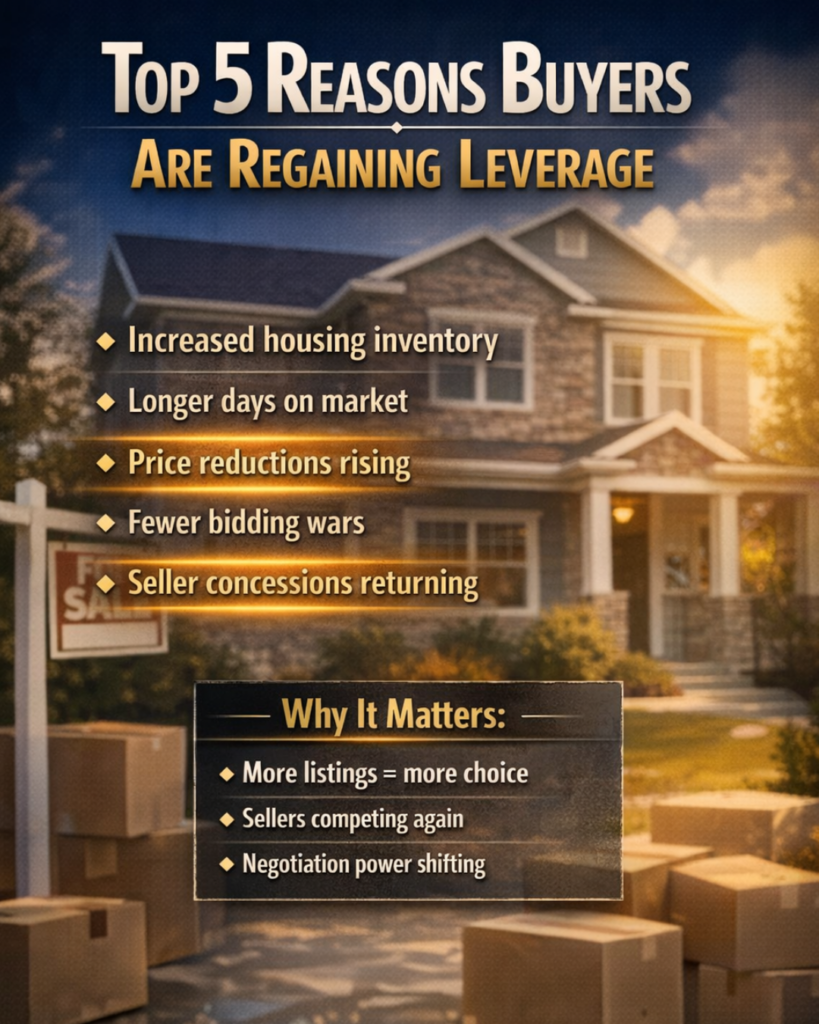
5 Reasons Raleigh Buyers Are Regaining Leverage
1. Increased Housing Inventory
More homes are coming to market across Raleigh and Wake County.
When supply increases:
- Buyers have more options
- Sellers face more competition
- Urgency begins to ease
This matters because affordability is not just about what you can pay—it is about the choices available to you.
When inventory is limited, buyers are often forced into faster decisions and stronger offers.
When inventory expands, that pressure starts to lift.
More inventory doesn’t just create choice—it reduces the likelihood of overpaying and improves your ability to align a home purchase with your long-term financial goals.
2. Longer Days on Market
Homes are taking longer to sell compared to the peak pace of the past few years.
That shift creates:
- More time to evaluate decisions
- More opportunity to negotiate
- Less pressure to act immediately
In Raleigh, this varies by price point and location—but the broader trend is clear.
Time introduces flexibility.
And flexibility improves outcomes.
When homes sit longer, sellers become more open to adjustments that impact not just price, but terms—and those terms often have a direct effect on your monthly payment.
3. Price Reductions Are Increasing
Sellers are beginning to adjust expectations.
Not dramatically—but consistently.
Price reductions signal:
- Increased competition among listings
- Greater seller awareness
- Willingness to engage with buyers
These adjustments create entry points that were unavailable under more competitive conditions.
In many cases, a price reduction improves more than just the purchase price—it can influence financing structure, down payment strategy, and long-term affordability.
For buyers in Raleigh, this creates opportunities to approach the market with greater precision rather than urgency.
4. Fewer Bidding Wars
While multiple-offer situations still exist, they are less common than they were at peak intensity.
That changes how buyers can approach the process.
You are more likely to:
- Include contingencies
- Avoid escalation clauses
- Structure offers with intention instead of reaction
Less competition creates space for better decision-making.
And better decision-making leads to stronger financial outcomes.
When you are not competing aggressively against multiple buyers, you gain the ability to focus on what actually matters: terms, structure, and long-term affordability.
5. Seller Concessions Are Returning
This is one of the most meaningful shifts for buyers in Raleigh right now.
Across Raleigh and Wake County, this shift is showing up more frequently in both resale and new construction transactions.
Sellers are increasingly open to contributing toward:
- Closing costs
- Interest rate buydowns
- Structuring incentives that improve your overall terms
This matters because affordability is not just about price—it is about payment.
In many cases, a seller concession can reduce your monthly payment more effectively than negotiating the purchase price alone.
For example, a strategically structured seller-paid buydown in Raleigh
allows the seller to fund a temporary or permanent reduction in your interest rate.
That means:
- Lower monthly payments
- Improved cash flow
- Greater flexibility in your overall financial plan
In today’s Raleigh market, this is one of the most effective ways to improve affordability without increasing your purchase price.
And importantly, it does not require you to bring additional cash to the table.
This is where leverage becomes practical—not theoretical.
It turns shifting market conditions into real, measurable affordability for Raleigh buyers.
How This Plays Out Differently in Raleigh vs National Headlines
National headlines often lag behind local reality.
Raleigh is not experiencing:
- A market crash
- A uniform slowdown
Instead, it is experiencing a rebalancing.
Key local dynamics:
- Continued population growth
- Strong job base (tech, healthcare, education)
- Submarket variation (Cary vs Fuquay vs Durham)
This means:
Leverage exists—but it must be applied strategically.
Costs, Tradeoffs, and What Actually Changes the Outcome
What truly impacts affordability:
- Seller contributions
- Loan structure
- Timing within a submarket
What matters less than most think:
- Waiting for the “perfect” rate
- Trying to predict the bottom
- Only focusing on purchase price
In Raleigh, structure often outweighs rate.
Common Misconceptions About Affordability in 2026
“If rates drop, affordability will improve”
Not necessarily. Prices often respond.
“I need 20% down to afford a home”
Not required in many scenarios.
“The market will get easier if I wait”
Opportunity cost is real.
“Approval equals affordability”
Approval is a ceiling. Not a strategy.
When Buying Makes Sense and When It Doesn’t
Makes sense when:
- You have clarity on your payment comfort
- You can take advantage of concessions
- You plan to stay long enough to benefit from ownership
May not make sense when:
- You are uncertain about timeline
- You are reacting to headlines instead of strategy
- You have not fully evaluated your options
Mistakes That Create Affordability Problems
- Shopping before understanding the structure
- Ignoring seller concessions
- Focusing only on the rate
- Using national advice for a local decision
These mistakes are avoidable with clarity.
How Kevin Martini and Martini Mortgage Group Help
This is where the difference shows up.
At Martini Mortgage Group, the approach is:
Clarity before commitment
Understand your numbers first.
Strategy before structure
Design the plan before choosing the loan.
Local expertise
Raleigh is not one market—it is many.
Fiduciary guidance
Advice is aligned with your outcome, not a transaction.
This is not about getting you approved.
It is about helping you make a decision that holds up over time.
Raleigh Homebuyer FAQ: Can I Afford to Buy in 2026?
Can I afford to buy a house in Raleigh NC in 2026?
Yes! Many buyers can, especially as inventory increases and seller concessions return. Affordability in Raleigh is improving due to better negotiation opportunities, not just lower prices.
What determines affordability in Raleigh’s housing market right now?
Affordability in Raleigh is driven by more than price and interest rates. Buyer leverage—such as negotiating seller concessions, rate buydowns, and terms- plays a major role in the monthly payment.
Are home prices dropping in Raleigh, NC?
Prices in Raleigh are not broadly declining, but price reductions are becoming more common. This creates opportunities for buyers to enter the market with improved terms and better positioning.
How do seller concessions improve affordability for Raleigh buyers?
Seller concessions can reduce upfront costs or lower monthly payments through rate buydowns. In Raleigh, this is one of the most effective ways to improve affordability without increasing purchase price.
Is now a good time to buy a house in Raleigh, North Carolina?
For many buyers, yes. With increased inventory, longer days on market, and fewer bidding wars, Raleigh is offering more favorable conditions than in recent years.
Should I wait for mortgage rates to drop before buying in Raleigh?
Waiting for lower rates can be risky, as increased demand may drive prices higher. Many Raleigh buyers benefit more from negotiating terms today and refinancing later if rates improve.
TL;DR: Can I afford to buy a house in Raleigh NC 2026
- Can I afford to buy a house in Raleigh NC 2026 depends on leverage, not just rates
- Inventory is increasing across Wake County
- Days on market are extending
- Price reductions are becoming more common
- Bidding pressure is easing
- Seller concessions are returning
Affordability is improving—but only if you understand how to use it.
Schedule a complimentary clarity call with Kevin Martini.
