
Bridge Loan: Buy Your Next Home Before You Sell
A bridge loan can help a qualified homeowner use equity in their current home to buy their next home before they sell it.
For homeowners in Raleigh, the Triangle, and throughout North Carolina, this can solve one of the hardest move-up buying problems: finding the right next home before the timing of the current-home sale has been resolved.
Kevin Martini and Logan Martini of Martini Mortgage Group approach that decision differently than simply asking, “How much can we borrow?” The more useful question is whether a bridge loan improves the entire financing structure…including access to equity, mortgage qualification, cash available for the next purchase, offer strategy, monthly obligations, and the plan for eventually selling the current home.
That distinction matters because a bridge loan does not mean your current mortgage disappears.
Bridge Loan Quick Answer
A bridge loan is short-term financing designed to bridge the financial gap between two transactions—typically purchasing a new home and selling a current home.
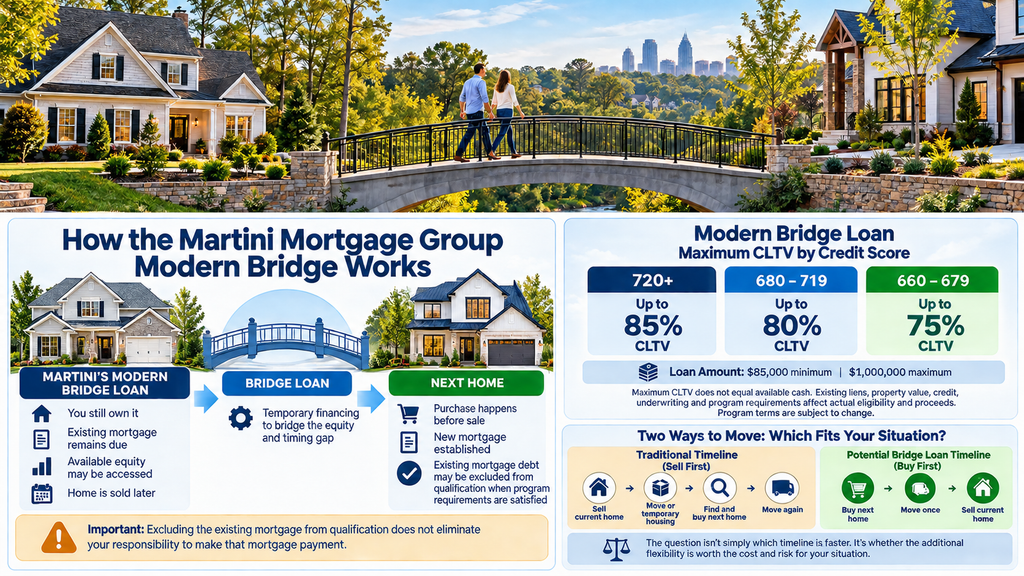
With the Martini Mortgage Group Modern Bridge Loan, an eligible homeowner may be able to access equity from the current residence for the next purchase without selling that home first.
Most importantly, the homeowner remains responsible for the existing mortgage until the current home is sold and that loan is paid off. However, under the Modern Bridge Loan structure, the existing mortgage debt can be excluded when qualifying the borrower for the new mortgage, provided program requirements are met.
That combination can address two different problems at once:
- Equity problem: Much of the homeowner’s available cash is tied up in the current house.
- Qualification problem: Carrying the existing mortgage may otherwise reduce the amount the homeowner can qualify to borrow for the next house.
The result can be more control over when to buy, when to move, and when to sell.
Martini Mortgage Group Modern Bridge Loan at a Glance
| Feature | Modern Bridge Loan |
|---|---|
| Primary purpose | Help an eligible homeowner buy before selling |
| Current mortgage | Remains in place until the home is sold and the mortgage is paid off |
| Qualification advantage | Existing mortgage debt may be excluded when qualifying for the new mortgage when program requirements are met |
| 720+ credit score | Up to 85% CLTV |
| 680–719 credit score | Up to 80% CLTV |
| 660–679 credit score | Up to 75% CLTV |
| Minimum bridge loan | $85,000 |
| Maximum bridge loan | $1,000,000 |
| First 120 days | No bridge-loan payments required; interest accrues and is deferred |
| Recasting new mortgage later | May or may not be available |
| Final eligibility | Subject to program requirements, credit and underwriting approval |
Program terms can change. Current eligibility and terms should always be confirmed for the individual borrower before making a purchase or sale decision.
What Is a Bridge Loan?
A bridge loan is temporary financing that bridges the gap between an immediate financial need and a future source of funds.
For a homeowner buying another home, that future source of funds is often the equity that becomes available when the existing home is sold.
That is why bridge loans can be particularly relevant to move-up buyers.
A homeowner may have substantial net worth tied up in the current residence without having that equity sitting in a checking or investment account. If the right next home becomes available before the current home is sold, the timing mismatch can become the obstacle.
The Martini Mortgage Group Bridge Loan is designed to address that mismatch.
Bridge financing isn’t unique to Martini Mortgage Group. Fannie Mae recognizes bridge or swing loans as a potential source of funds subject to applicable requirements in its Selling Guide. The exact underwriting treatment of bridge financing and other housing obligations depends on the new mortgage program and the borrower’s circumstances.
For borrowers who want to understand the broader agency framework, review Fannie Mae’s official bridge/swing loan guidance.
Does a Bridge Loan Pay Off Your Current Mortgage?
No. A bridge loan does not automatically make your current mortgage go away.
This is one of the most important points to understand about the Modern Bridge Loan.
If you still own the current home and its first mortgage has not been paid off, you remain responsible for that mortgage. You must continue making the required payments until the home is sold and the existing loan is paid off or otherwise satisfied.
The Martini Mortgage Group Modern Bridge Loan offers a different advantage.
When you meet program requirements, you can exclude the existing mortgage debt when qualifying for the new mortgage.
That distinction is critical:
You still owe the current mortgage payment. It may not have to count against you for qualification under the Modern Bridge Loan structure.
Those are two very different concepts.
For some homeowners, that qualification difference can matter as much as accessing the equity itself.
Why Can Excluding the Existing Mortgage Matter So Much?
Mortgage qualification considers income and recurring obligations. A homeowner trying to buy before selling can therefore encounter a frustrating problem.
The homeowner may comfortably afford the new home once the current property sells, but including the existing mortgage in the qualification equation can temporarily constrain the new purchase.
Consider a simple illustrative example.
Assume a homeowner has:
- an existing home worth $600,000;
- a $250,000 current mortgage balance;
- significant equity in that property; and
- a desire to purchase the next home before completing the sale of the current residence.
At an 85% CLTV ceiling, 85% of $600,000 equals $510,000.
After accounting for the hypothetical $250,000 existing mortgage balance, the mathematical difference is $260,000.
That does not mean the homeowner automatically qualifies for or receives a $260,000 bridge loan.
Property valuation, existing liens, credit, underwriting, program requirements, loan limits, costs, and other factors affect the actual amount available.
The example illustrates the underlying problem: a homeowner can have substantial wealth in a property without equivalent liquid cash for the next transaction.
How Much Equity Can You Access With the Modern Bridge Loan?
The maximum combined loan-to-value, or CLTV, under the Modern Bridge Loan depends in part on the borrower’s credit profile:
- 720 or higher: up to 85% CLTV
- 680–719: up to 80% CLTV
- 660–679: up to 75% CLTV
The minimum Martini Mortgage Group Modern Bridge Loan amount is $85,000, and the maximum is $1 million.
It is important to understand what those percentages mean.
An 85% CLTV does not mean the homeowner can necessarily borrow 85% of the home’s total value as new cash.
CLTV considers the combined debt secured by the property relative to its value.
Using the earlier $600,000 example, an 85% CLTV represents $510,000 of total debt against the property. Existing liens must therefore be considered when determining the potential bridge-loan amount.
That distinction matters when estimating how much equity may actually be available for the next purchase.
Do You Make Payments on a Bridge Loan Right Away?
Under the current Martini Mortgage Group Modern Bridge Loan structure described here, no bridge-loan payments are required during the first 120 days.
That does not mean the financing is interest-free.
Interest accrues during that period. Rather than requiring monthly payments during those first 120 days, the accrued interest is deferred and collected at maturity.
That can reduce the immediate cash-flow pressure associated with purchasing the next home before selling the current one.
But payment deferral is not interest forgiveness.
A homeowner evaluating a bridge loan should therefore consider the strategy’s total expected cost, not simply whether an immediate monthly bridge-loan payment is required.
What Happens to Your Current Mortgage While the Bridge Loan Is Open?
You continue making the required payment on your current mortgage.
The bridge-loan payment deferral does not create a payment holiday on the first mortgage attached to your existing home.
This is why a thoughtful bridge-loan analysis should consider two different questions:
Can you qualify for the transaction?
And:
Are you comfortable with the actual household cash flow while you still own both homes?
Those are not necessarily the same answer.
A borrower can satisfy underwriting requirements and still decide that carrying the current-home payment for an extended period would create more financial pressure than they want.
The strategy needs to work on paper and in real life.
Can a Bridge Loan Help You Make a Stronger Offer?
Potentially.
A homeowner whose purchase depends on selling the current property may otherwise need to make an offer contingent on that sale.
When bridge financing solves equity and qualification constraints, the buyer may be able to purchase without making the sale of the existing home a prerequisite.
That can matter because sellers evaluate more than price. The number and nature of contingencies can affect an offer’s perceived certainty.
The Bridge program materials identify the ability to buy before selling, avoid a sale contingency, and potentially make a stronger offer as benefits of this type of strategy.
A bridge loan does not make an offer identical to cash, eliminate every possible contingency, or guarantee that a seller will prefer the offer.
It means the financing structure can potentially remove one obstacle from the purchase.
For buyers who want to strengthen financing certainty further, Martini Mortgage Group’s Same-As-Cash Mortgage Approval focuses on completing deeper financing validation before an offer is made.
Bridge Loan vs. HELOC: What’s the Difference?
Both strategies can unlock home equity, but they shouldn’t be treated as interchangeable.
| Question | Modern Bridge Loan | HELOC |
|---|---|---|
| Can it access current home equity? | Yes, subject to eligibility | Potentially |
| Designed specifically around buying before selling? | Yes | Not necessarily |
| Existing mortgage disappears? | No | No |
| Treatment of current mortgage for new-loan qualification | May be excluded when Modern Bridge Loan requirements are satisfied | Must be evaluated under applicable underwriting rules |
| New equity-access debt created? | Yes | Yes |
| Right for every homeowner? | No | No |
A HELOC can be an effective strategy for some homeowners. Martini Mortgage Group’s guide to buying before selling in Raleigh discusses that broader move-up strategy and the role equity-access tools can play.
But opening a HELOC solely because equity is available can miss the larger issue.
The better question is:
Which structure solves the homeowner’s actual constraint with an acceptable combination of qualification, cash flow, cost, flexibility and risk?
That is Strategy Before Structure.
Can You Recast the New Mortgage After Your Old Home Sells?
Maybe—but recasting should not be assumed.
A common strategy after selling the old home is to take some or all of the sale proceeds and apply them to the principal balance of the new mortgage.
Some homeowners then want the lender or servicer to recast the new mortgage, recalculating the scheduled monthly principal-and-interest payment using the lower outstanding principal balance while generally retaining the existing loan’s interest rate and remaining term.
But recasting is not universally available.
Availability can depend on the mortgage product, investor, servicer and applicable requirements.
Therefore, a homeowner should not build the entire bridge-loan strategy around an assumption that the new mortgage will definitely be recast after the old property sells.
Before closing, Martini Mortgage Group can model the financing both ways:
- What does the strategy look like if a future recast is available?
- What does the strategy look like if it is not?
If the entire plan works only when an uncertain future event occurs, that uncertainty belongs in today’s decision.
What If Your Current Home Takes Longer Than Expected to Sell?
This is one of the most important bridge-loan risks to evaluate before borrowing.
Buying first gives the homeowner more control over the moving timeline, but it also means the current property may remain unsold longer than expected.
During that period, the homeowner remains responsible for obligations associated with the current property.
Before using a bridge loan, consider:
- How long could you comfortably carry the existing mortgage?
- What happens if the current home sells for less than expected?
- How much liquidity will remain after purchasing the next home?
- How much interest and other costs could accumulate on the bridge financing?
- What is the repayment plan if the home takes longer to sell?
- Does the overall strategy still work if the new mortgage cannot be recast?
A bridge loan should create flexibility—not simply move today’s financial pressure several months into the future.
How Can a Bridge Loan Help Raleigh and Triangle Homeowners?
For homeowners in Raleigh and the Triangle, the value of a bridge loan is primarily about transaction sequencing, not a special North Carolina bridge-loan rule.
A homeowner in Raleigh may find the right next property in Cary, Apex, Wake Forest, Holly Springs or another Triangle community before being ready to complete the sale of the existing residence.
Selling first solves the equity problem, but it can create another problem:
Where do you live while searching for the next home?
Buying first may allow an eligible homeowner to:
- secure the desired next property before selling;
- move once instead of arranging temporary housing;
- prepare the previous home for sale after moving out;
- separate the purchase negotiation from the pressure to close the old home simultaneously; and
- potentially make an offer without a current-home-sale contingency when the financing structure permits it.
None of those advantages automatically means buying first is financially superior.
They mean timing has value.
The decision is whether the value of that flexibility outweighs the cost and risk of creating the bridge.
Who May Be a Good Candidate for a Bridge Loan?
A bridge loan may deserve consideration when a homeowner:
- has meaningful equity in the current residence;
- wants to buy the next home before selling;
- needs current-home equity for the next transaction;
- faces a qualification constraint because of the existing housing obligation;
- wants to reduce dependence on a home-sale contingency;
- understands the cost of temporary financing; and
- has a credible strategy for selling the current property and repaying the bridge loan.
A bridge loan may be less attractive when the homeowner has limited equity, insufficient financial reserves, an uncertain sale strategy, or can accomplish the same objective with a simpler or lower-cost structure.
That leads to an important principle:
Eligibility is not the same thing as suitability.
Getting a bridge loan doesn’t automatically mean it’s the best financial strategy.
How Should You Decide Whether to Use a Bridge Loan?
Start with the desired outcome, not the loan product.
Step 1: Determine your equity position
Estimate the current property’s value, existing mortgage balance and other liens to understand how much equity may realistically be accessible.
Step 2: Identify the actual problem
Is the obstacle:
- cash for the next purchase;
- qualifying while carrying the existing mortgage;
- making an offer contingent on selling;
- coordinating two closings;
- avoiding temporary housing;
- or some combination of these?
The right financing structure depends on the problem you are actually solving.
Step 3: Model the new purchase
Determine the right financing for the next home before deciding how much bridge financing you need.
Martini Mortgage Group’s broader mortgage loan options resource can help establish the available financing landscape before layering an equity strategy on top of it.
Step 4: Stress-test the old-home sale
Do not model only the perfect scenario.
Ask what happens if the current home takes longer to sell or sells for less than expected.
Step 5: Compare the alternatives
Compare the bridge loan against alternatives that may be available, including:
- selling first;
- using a HELOC when appropriate;
- using available liquid assets;
- changing the down payment;
- using another acceptable financing structure; or
- adjusting the timing of the purchase.
Step 6: Plan the exit before entering the bridge
Know how the bridge loan is expected to be repaid.
Also understand what you expect to do with the new mortgage after the current property sells—and whether that plan depends on recasting being available.
This is where Martini Mortgage Group’s fiduciary-style approach becomes important.
The goal is not to start with a bridge loan and justify it afterward.
The goal is to determine whether bridge financing improves the homeowner’s complete mortgage strategy.
Frequently Asked Questions About Bridge Loans
What is a bridge loan in real estate?
A bridge loan is temporary financing that helps bridge the financial timing gap between buying a new property and selling an existing property. For homeowners, it can potentially provide access to current-home equity before the existing home is sold.
Can I use a bridge loan to buy a house before I sell mine?
Yes. Buying before selling is one of the primary uses of residential bridge financing. Eligibility, available equity, credit, underwriting and the financing structure of the new purchase still matter.
Does a bridge loan eliminate my existing mortgage payment?
No. The existing mortgage remains the homeowner’s obligation until it is paid off. Under the Modern Bridge Loan structure, however, the existing mortgage debt can be excluded when qualifying for the new mortgage when program requirements are satisfied.
How much can I borrow with the Modern Bridge Loan?
Current Modern Bridge Loan program parameters allow up to 85% CLTV with a 720+ credit score, 80% with a 680–719 score, and 75% with a 660–679 score. The minimum bridge loan is $85,000, and the maximum is $1 million. Actual eligibility and available proceeds depend on the complete transaction.
Do I have to make a bridge-loan payment immediately?
Under the Modern Bridge Loan structure described here, no bridge-loan payments are required for the first 120 days. Interest still accrues during that period and is deferred rather than forgiven.
Is a bridge loan the same as a HELOC?
No. Both can potentially provide access to home equity, but their structures, qualification treatment, repayment terms and intended uses can differ. They should be compared within the homeowner’s complete financing strategy.
Can a bridge loan help me avoid a home-sale contingency?
Potentially. If bridge financing solves the equity and qualification issues created by buying before selling, a buyer may be able to structure the next purchase without making it contingent on first selling the existing home. The specific purchase contract and financing circumstances still matter.
Can I recast my new mortgage after my current home sells?
Possibly, but it should never be assumed. Recast availability depends on the new mortgage and applicable investor and servicer requirements. A strong bridge strategy should be evaluated both with and without a future recast.
What happens if my current home does not sell within 120 days?
The 120-day payment feature does not eliminate the bridge-loan obligation or the interest that accrues. Before using the Modern Bridge Loan, the borrower should understand the applicable maturity, repayment requirements, costs and strategy if the existing property takes longer than expected to sell.
Is a bridge loan a good idea?
A bridge loan can be useful when it solves a real timing, equity or qualification problem at an acceptable cost and level of risk. It is not automatically the right choice simply because a homeowner has substantial equity.
The Bottom Line on Bridge Loans
A bridge loan can help a homeowner use current-home equity to purchase the next home before selling, but accessing equity is only part of the decision.
The Modern Bridge Loan can be particularly powerful when the existing mortgage would otherwise interfere with qualification for the new mortgage.
The homeowner continues making the current mortgage payment until the home sells and the existing loan is paid off. But when the Martini Mortgage Group Modern Bridge Loan requirements are satisfied, the existing mortgage debt can be excluded when qualifying for the new mortgage.
That can separate three events homeowners often assume must happen simultaneously:
buy the next home → move → sell the current home
For the right homeowner, that flexibility can change the entire transaction.
But flexibility has a cost. Bridge financing should be evaluated against the homeowner’s equity, credit profile, actual cash flow, expected sale timeline, new mortgage, repayment strategy, and available alternatives.
Kevin Martini and Logan Martini at Martini Mortgage Group can model the transaction before you commit to the next home, including what the strategy looks like if the existing home takes longer to sell or a future mortgage recast is unavailable.
The objective is not simply to determine whether you can use a bridge loan.
It is to determine whether a bridge loan creates the strongest overall path from the home you own today to the home you want next.
Home loan first. Then home. Strategy Before Structure.