3% vs 20% Down Payment in Raleigh: Which Is Smarter?
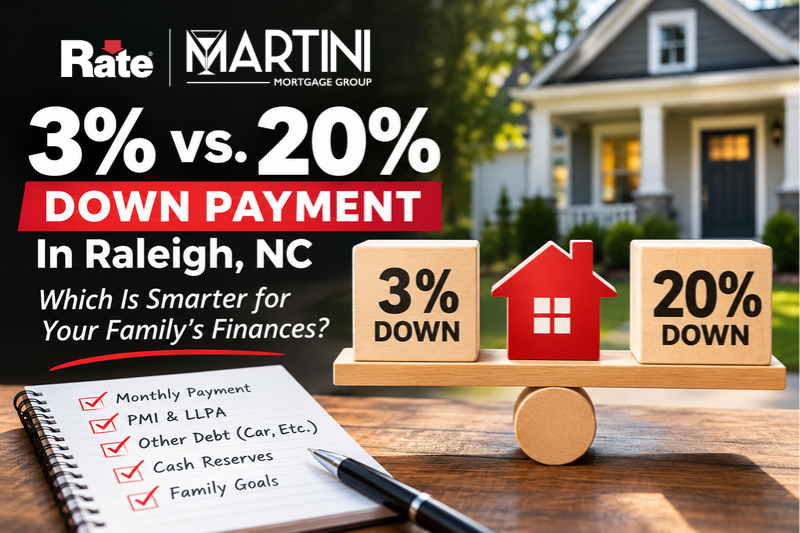
The 3% vs 20% down payment Raleigh NC decision is not simply about avoiding mortgage insurance. It’s about deciding where your family’s money can do the most good. A larger down payment can reduce borrowing and build immediate equity. A smaller one can preserve emergency savings or leave room to address other debts. Neither choice is automatically right.
At Martini Mortgage Group, a Raleigh mortgage lender team at Rate, Certified Mortgage Advisor Kevin Martini (NMLS 143962) and VP of Mortgage Lending Logan Martini (NMLS 1591485) help buyers compare mortgage structures against their entire financial picture—not just the mortgage in isolation.
The question to ask before choosing a down payment: Will this decision leave our family financially stronger after we move in?
At a Glance: What Should Raleigh Buyers Know?
- You don’t necessarily need 20% down. Eligible buyers may qualify for conventional low-down-payment options; eligibility and program restrictions apply.
- PMI is a cost, not necessarily a permanent cost. Many conventional loans allow borrower-paid private mortgage insurance to be cancelled under applicable rules.
- Excellent credit can matter. Mortgage insurance and loan pricing depend on borrower and loan characteristics, so generic PMI estimates are not reliable quotes.
- More down is not always the best use of cash. Money used to pay off other debt or preserve reserves may improve financial flexibility, but can also increase mortgage borrowing costs.
- Compare the entire plan. Ask about financing, mortgage insurance, remaining cash, other debt, time horizon and the risk of unexpected expenses.
3% vs 5% vs 10% vs 20% Down: What Actually Changes?
| Decision factor | 3% down | 5% down | 10% down | 20% down |
|---|---|---|---|---|
| Upfront down-payment cash | Least of these four | More | More | Most |
| Initial mortgage balance | Highest | Lower | Lower | Lowest |
| Conventional borrower-paid PMI | Typically required | Typically required | Typically required | Generally not required |
| Cash potentially retained for reserves or debt | Most, all else equal | Less | Less | Least |
| Initial equity | Lowest | Higher | Higher | Highest |
| Overall cost | Must be individually quoted | Must be individually quoted | Must be individually quoted | Must be individually quoted |
This table describes broad structural differences, not a personalized loan quote. Some programs have different eligibility, insurance and pricing requirements. The minimum permitted down payment is not necessarily the best down payment for a particular family.
Is It Better to Put 3% or 20% Down on a House?
Putting 20% down may be better when you can comfortably afford it while maintaining adequate reserves and meeting your other goals. Putting less down may be better when preserving liquidity or addressing other obligations creates a stronger overall financial position. The decision should be based on actual loan terms and a complete household budget.
A down payment moves money from an accessible account into home equity. Equity is valuable, but it is not the same as immediately available cash. Accessing it later may require a loan, sale or refinance, each with its own costs and eligibility requirements.
The opposite trade-off also matters: borrowing more can mean more interest over time and, on many conventional loans, mortgage insurance. Keeping cash isn’t free if the resulting loan costs more. This is why one rule of thumb cannot settle the question.
Is Paying PMI Worth It Instead of Putting 20% Down?
PMI can be a reasonable trade-off when the cost of insurance is outweighed by the value of keeping cash available, but it is not automatically the cheaper option. On conventional loans, private mortgage insurance generally protects the lender if the borrower defaults; it does not protect the homeowner from foreclosure. For a deeper look at the insurance trade-off, read our guide to mortgage terms Raleigh homebuyers should know.
The right comparison is not simply “PMI or no PMI.” Ask what cash you would give up to eliminate PMI, what other debt you carry, what reserves you would retain and how long the insurance may be required.
A buyer with a strong credit profile may find the PMI trade-off more acceptable than expected. Another buyer, especially one with less favorable insurance pricing, may reach the opposite conclusion. Both outcomes are possible.
Is PMI cheaper with excellent credit?
Strong credit can contribute to more favorable PMI pricing, but no single premium applies to all excellent-credit buyers. Pricing also depends on loan-to-value ratio, coverage requirements, loan features, and insurer terms. Request a borrower-specific quote for each down-payment option rather than relying on a generic internet estimate.
Can PMI be removed without refinancing?
Yes, on many conventional mortgages with borrower-paid PMI. Under the Homeowners Protection Act, eligible borrowers can generally request cancellation when the principal balance reaches 80% of the property’s original value, subject to written request, payment-history and other requirements. Automatic termination generally occurs when the loan is scheduled to reach 78% of original value if the borrower is current. Certain investor rules may permit earlier cancellation, subject to conditions. FHA insurance and lender-paid mortgage insurance follow different rules. For the steps, timing, and conditions, see our Raleigh guide to cancelling conventional PMI.
Do not build a plan that assumes your property will appreciate enough to eliminate PMI quickly. Appreciation and future refinancing are uncertain.
Does Putting 20% Down Always Get You a Better Mortgage Rate?
No. More down does not automatically guarantee the best pricing in every loan structure. Conventional mortgage pricing depends on multiple characteristics, including credit score, loan-to-value ratio, occupancy, program and applicable loan-level price adjustments (LLPAs). The mortgage insurance requirement must also be evaluated.
Fannie Mae publishes an official LLPA matrix with adjustments that vary across credit-score and loan-to-value combinations. Some eligible affordable lending transactions have different treatment. An LLPA is not itself a quoted mortgage rate or a complete measure of total borrowing cost. For the larger decision about cash and equity, read our guide to putting more money down versus keeping cash..
The practical lesson is simple: compare actual options rather than assuming the highest down payment automatically delivers the most attractive financing.
Should I Pay Off My Car Before Buying a House?
Paying off a car loan before buying may improve your household cash flow and sometimes your mortgage qualification, but it can also leave you with less cash for the home purchase. The right answer depends on the car loan’s remaining terms, how a larger mortgage would be priced, your reserves and the overall cost of borrowing.
Imagine you have money earmarked for your down payment and a car loan with a remaining balance. One option is to put all the earmarked money into the house and continue paying the car loan. Another is to make a smaller down payment and use some cash to retire the vehicle debt.
The second option could remove a separate household obligation. But the extra mortgage debt might remain outstanding long after the original car loan would have ended. It could also change PMI and financing costs. A reduction in monthly obligations is not proof of lower lifetime costs.
Before choosing, compare the options side by side:
- Household cash flow: Which obligations remain after closing?
- Total cost: What interest, PMI and other financing costs apply over the expected ownership period?
- Qualification: How would paying off the car affect debt-to-income analysis and required cash reserves?
- Liquidity: How much accessible savings remains in each scenario?
- Risk: Would moving short-term debt into longer-term mortgage borrowing expose the family to additional costs or financial vulnerability?
This is why a mortgage conversation should include the family’s other financial obligations, not just the home purchase.
Should I Use All My Savings for a Down Payment?
Generally, using all available savings for a down payment creates a liquidity risk that deserves serious consideration. A larger down payment can reduce financing costs, but it may also leave the family less prepared for repairs, moving expenses, income disruptions and other emergencies.
Think about the first year after closing. A home may need maintenance sooner than expected. Your insurance or utility costs may change. Furniture, childcare, commuting or family obligations can alter your budget. A mortgage structure that looks attractive on closing day may feel less comfortable if it leaves no margin for surprises.
There is no universal reserve target that fits every household. Discuss the amount you want to retain based on employment stability, dependents, property condition and other commitments.
What Is Different About Buying a Home in Raleigh and Wake County?
North Carolina buyers should consider due diligence obligations and other upfront transaction costs before deciding how much cash to put toward the down payment. Due diligence fees are generally negotiated and paid to the seller under the applicable contract; buyers should understand when those funds may be at risk if a transaction does not close.
For buyers in Raleigh, Cary, Apex, Wake Forest, Holly Springs, Durham and the Triangle, the right strategy also depends on property condition, taxes, insurance, HOA obligations and expected maintenance. These expenses can matter more to the family budget than the down-payment percentage alone.
For more on why keeping reserves can matter, see More Money Down or Keep Cash When Buying a Home in Raleigh. A mortgage calculator may estimate one loan scenario. It cannot fully evaluate your other debt, your savings priorities or your comfort with financial uncertainty.
When Is 20% Down the Stronger Choice?
A larger down payment may be especially compelling when you have ample savings remaining, little high-cost debt, a long ownership horizon and a strong preference to reduce mortgage borrowing. Avoiding conventional PMI can be valuable, and reducing principal can lower the amount of interest paid over time.
Do not dismiss 20% down merely because a smaller down payment is available. The objective is not to minimize cash at closing. It is to select a financing structure that fits the family’s priorities.
When Might a Smaller Down Payment Be Better?
A smaller down payment may deserve consideration when it helps preserve essential reserves, manage other debts or fund foreseeable family needs without making the mortgage unaffordable. This strategy is strongest when the borrower understands the resulting PMI, loan pricing and longer-term cost trade-offs.
The availability of a low-down-payment program does not establish that it is the right choice. Eligibility, property type, loan limits and underwriting still matter.
A Five-Question Down-Payment Decision Framework
Before committing cash to a Raleigh home purchase, ask:
- What will the entire family budget look like after closing? Include housing, transportation, childcare, insurance, other debt and savings.
- How much accessible cash should remain? Consider emergencies, repairs and known near-term expenses.
- What is the real PMI and financing difference? Obtain current, personalized comparisons rather than assumptions.
- How long do we expect to keep this mortgage or own this home? Time horizon affects the total-cost comparison; do not assume a refinance will be available.
- What would make us feel financially stronger a year from now? More equity, less other debt, stronger reserves or some combination?
The strongest down payment is not necessarily the largest. It is the one that supports the financial plan you can live with after closing.
Frequently Asked Questions About 3% vs 20% Down Payment Raleigh
Do first-time homebuyers need 20% down in Raleigh?
No. Eligible buyers may have access to conventional loans with smaller down payments, while FHA, VA and USDA programs may offer other structures subject to their own rules. Loan eligibility, property eligibility and applicable requirements determine which options are actually available. Start with our North Carolina first-time homebuyer resources and NC 1st Home Advantage down payment guide.
Is 5% or 10% down better than 3%?
Sometimes. A modestly larger down payment can reduce the loan balance and may change mortgage insurance or pricing, but it also uses cash that could remain available for reserves or other priorities. Compare all relevant options with actual loan terms.
Does PMI disappear automatically?
For many eligible conventional loans with borrower-paid PMI, automatic termination generally occurs at the scheduled 78% original-value threshold when the borrower is current. Borrowers may also qualify to request earlier cancellation. FHA mortgage insurance and lender-paid arrangements are different. See the Martini Mortgage Group’s PMI cancellation guide.
Can I use money I saved for a down payment to pay off other debt?
Potentially, but first confirm the resulting down payment, required funds to close, reserve requirements and underwriting treatment. Paying off debt may improve cash flow or qualification, while a larger mortgage may raise total financing costs. A personalized comparison is essential.
Does 20% down make a purchase offer stronger?
Not automatically. A seller may consider the buyer’s financing contingency, earnest money and due diligence terms, appraisal risk, loan approval strength and overall contract certainty. A larger down payment can help in some situations but does not replace a well-supported approval.
Is it better to pay PMI or wait until I have 20% saved?
There is no universal answer. Waiting may improve reserves or reduce financing costs, but it also changes when you can purchase and may expose you to different market conditions. Compare your financial readiness, PMI costs, future savings needs and the risk of buying before you are comfortable.
Is a lower mortgage payment always the best financial outcome?
No. Lower mortgage obligations may be helpful, but household debt, accessible savings, interest costs, insurance and the length of time debt remains outstanding all affect the outcome. A good financing strategy evaluates the whole picture.
The Martini Strategic Insight
A mortgage is only one part of your family’s financial life. It should not be optimized at the expense of everything around it.
The right down payment may be the one that creates more equity. It may be the one that leaves more cash available. Or it may be the one that allows you to manage other obligations while keeping the home affordable.
At Martini Mortgage Group, Kevin and Logan Martini help Raleigh-area buyers examine those trade-offs before choosing a loan structure.
Strategy Before Structure. Home Loan First. Then Find Your Home.
Let’s Run the Whole-Budget Comparison
Before deciding how much to put down, compare the mortgage, mortgage insurance, other debt and cash reserves together. Contact Martini Mortgage Group at (919) 238-4934 or Martini@Rate.com to discuss your options.